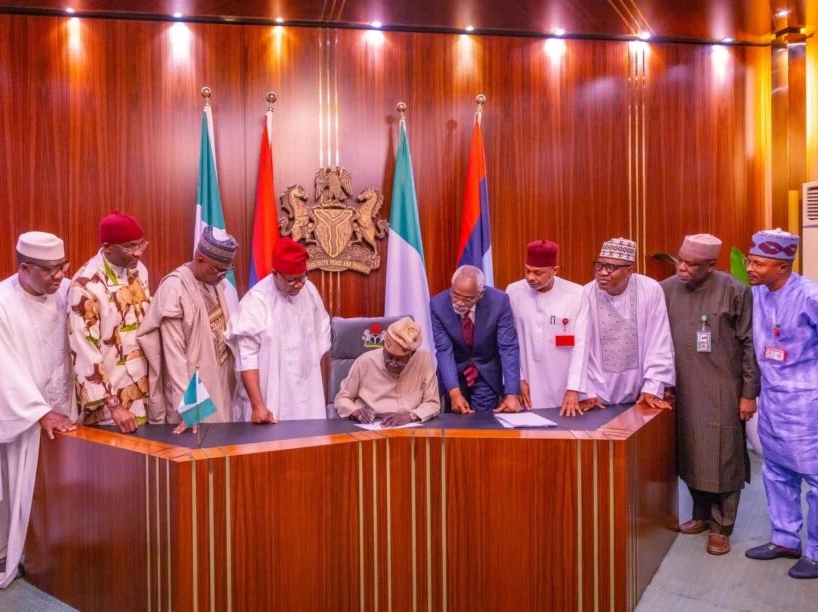
President Bola Tinubu has defended his decision to sign the Electoral Act 2026 (Amendment) into law, insisting that credible elections depend more on transparent human oversight than on real-time electronic transmission of results.
Speaking after signing the amendment at the Presidential Villa in Abuja, Tinubu addressed the heated debate over whether election results must be uploaded live from polling units to the server of the Independent National Electoral Commission (INEC).
According to the President, election credibility rests on effective process management, not just technology. He emphasised that elections are ultimately conducted, supervised, and concluded by people — not computers.
“No matter how advanced the system is, it is managed and finalised by human beings,” Tinubu said, noting that final results are declared by designated electoral officials, not machines.
Manual Voting Still Central
Tinubu reiterated that Nigeria’s voting process remains fundamentally manual — from ballot issuance and thumb-printing to counting and collation. He explained that what is electronically transmitted is simply the arithmetic record entered into Form EC8A after manual collation at polling units.
He also raised concerns about Nigeria’s broadband infrastructure, questioning whether the country is technically equipped for seamless real-time electronic transmission nationwide.
What the Amendment Says
The amended law retains electronic transmission of results but stops short of making real-time uploads mandatory. Instead, it allows manual collation as a fallback where network challenges occur.
The decision followed intense debate in the National Assembly, with critics arguing that the flexibility could create room for manipulation. However, under the final version signed into law, results must be electronically transmitted after Form EC8A is signed and stamped. Where transmission fails, the manually signed result becomes the basis for collation and declaration.
Tinubu maintained that the amendment safeguards democracy while ensuring stability, transparency, and the continued growth of Nigeria’s electoral process.