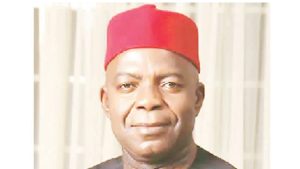
Senate President Godswill Akpabio has defended the Senate’s amendment of the Electoral Act, insisting that critics have misunderstood the legislative process.
Addressing concerns over the reported removal of real-time electronic transmission of election results, Akpabio clarified that the amendment does not eliminate electronic transmission but instead questions the mandate for real-time results.
Speaking in Abuja as a special guest at the launch of the book The Burden of Legislators in Nigeria by Senator Effiong Bob, Akpabio emphasized that the Electoral Act amendment is still ongoing and public criticism is premature.
“The Electoral Act amendment is incomplete. We have not completed it, but they are already on television. They don’t understand lawmaking,” he said, noting that final decisions will follow the Senate’s Votes and Proceedings.
The clarification comes after the Nigerian Bar Association (NBA) called for mandatory electronic transmission of election results, warning that the Senate’s current approach—allowing INEC to prescribe the mode of result transfer—could weaken transparency and invite ambiguity.
Akpabio highlighted practical concerns with real-time transmission, including network failures and national grid issues, which could invalidate election results in areas with poor connectivity or insecurity.
“All we said was that we should remove the word ‘real time,’ because if you say real time and there is a grid failure, when you go to court, somebody will say it ought to have been real time,” he explained.
He added that INEC should determine the mode and timing of election result transmission within the legal framework. Akpabio also criticized civil society actors who he said were attempting to influence legislative decisions from outside the lawmaking process.
“People have become mouth legislators. Go and contest elections if you want to make laws. Retreats are part of consultations, not lawmaking,” he said.
The Senate President stressed that electoral reforms must consider legal, technological, and institutional capacity, warning that enforcing real-time electronic transmission could risk elections in areas with infrastructure challenges.
Supporting this view, former Senate President and ADC National Chairman David Mark urged the National Assembly to pass the amendment and leave the implementation of real-time transmission to INEC.
The book launch also featured remarks by Akwa Ibom Governor Pastor Umo Eno and Prof. Maxwell Gidado SAN, who lauded Senator Bob for highlighting the difficulties Nigerian legislators face, including electoral disputes, conflicts with political godfathers, and judicial challenges.