By Jesse Ese
National News – For decades, Nigeria has maintained a system where oil companies are fined for gas flaring—yet the very practice those penalties are meant to deter continues almost unchecked across the Niger Delta, raising troubling questions about whether the system has become a license to pollute rather than a tool for environmental protection.
Nigeria remains one of the world’s top gas-flaring nations, ranking among the highest globally alongside countries like Russia and Iraq, according to data from the World Bank Global Gas Flaring Reduction Partnership.
Despite decades of commitments, billions of cubic meters of gas are still burned annually across oil fields in the country.
In theory, gas flaring penalties are designed to compel compliance with environmental standards. In practice, however, many industry observers argue that the fines are too low to drive real change, allowing operators to simply factor them into the cost of doing business.
This contradiction has created a cycle where the government collects revenue from gas flaring while communities continue to suffer the environmental and health consequences of the practice.
Environmental advocates say the situation reflects a deeper failure of enforcement and political will, one that prioritizes revenue generation over the well-being of citizens.
At the forefront of this concern is Dr. Fyneface Dumnamene, Executive Director of the Youth and Environmental Advocacy Centre (YEAC), who has spent years campaigning against environmental degradation in the region.
“Government has put in place laws to regulate gas flaring, but the implementation has not been as effective as expected,” he said.
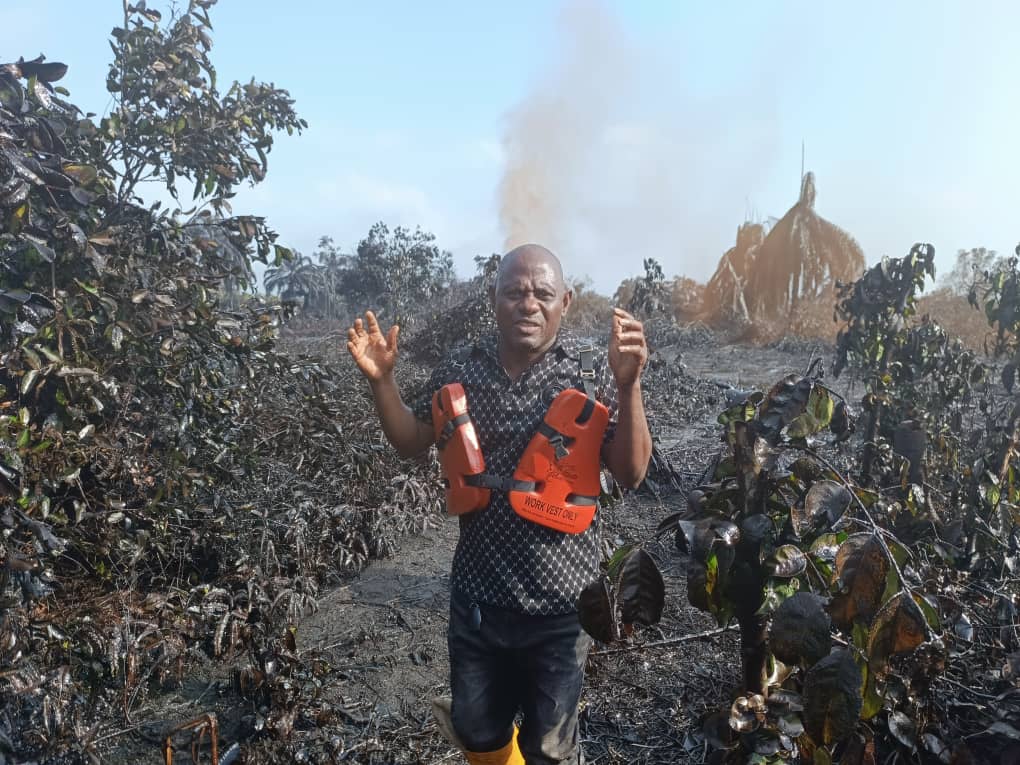
Field Work: Dr. Fyneface at the Oil Well 14 spill site in Kpean Community. Credit: YEAC
According to him, both multinational and indigenous oil companies continue to flare gas because it remains more economically viable than investing in alternatives.
“The penalties are not strong enough. It is easier for companies to pay fines than to stop gas flaring,” he explained.
Nigeria has set a target to end routine gas flaring and achieve net-zero emissions by 2060, but current realities suggest the country is far from meeting those goals.
Data from the Nigerian Upstream Petroleum Regulatory Commission indicates that Nigeria still flares hundreds of millions of standard cubic feet of gas daily, translating into significant economic losses and environmental damage.
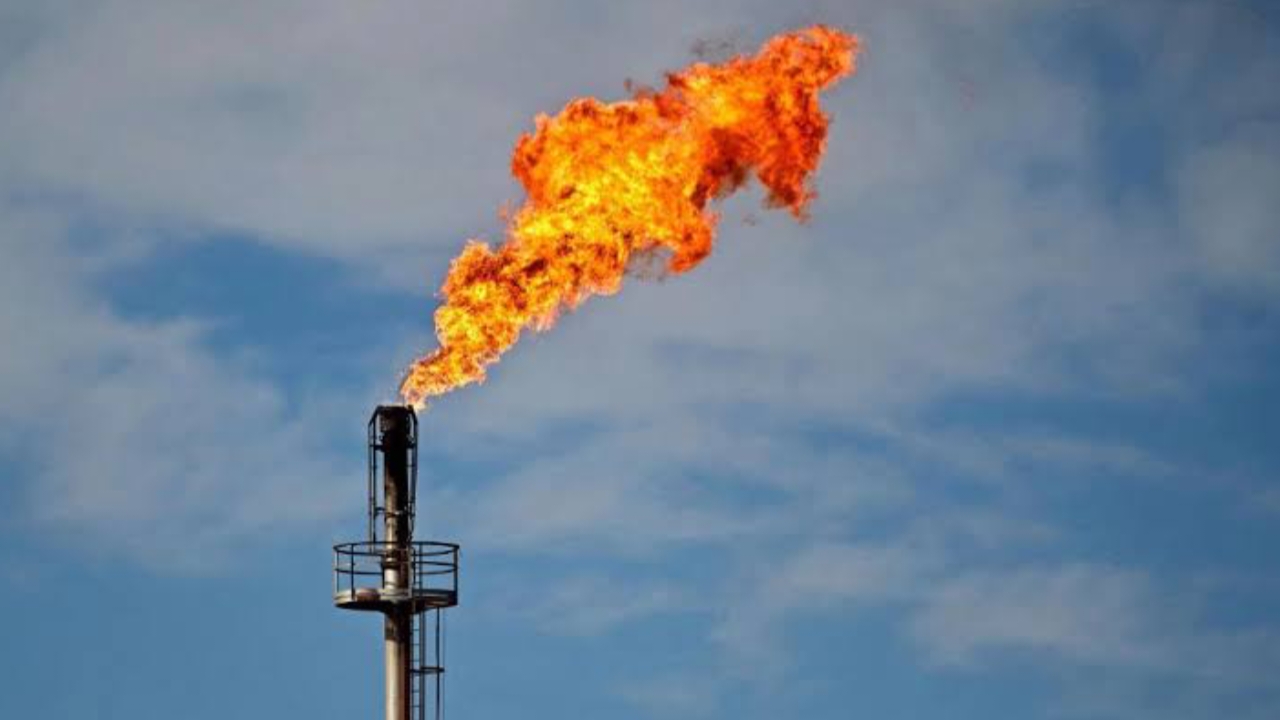
Across the Niger Delta, gas flaring persists in both remote and populated areas, with towering flames and thick smoke marking the landscape.
Beyond its environmental toll, gas flaring represents a major economic waste. The World Bank estimates that billions of dollars are lost annually due to flared gas that could otherwise be harnessed for power generation.
For many residents, the constant burning of gas is a daily reality that affects every aspect of life.
The flares release pollutants such as carbon dioxide, methane, and black carbon—major contributors to climate change.
According to the United Nations Environment Programme, prolonged exposure to such pollutants increases the risk of respiratory diseases, cancer, and other serious health conditions.
“What we see here is black smoke, which shows incomplete combustion. It is dangerous to human health,” Fyneface said.
Beyond the air, the impact extends to water and soil, contaminating essential resources that communities rely on.
A landmark assessment by the United Nations Environment Programme in Ogoniland found that benzene levels in drinking water were up to 900 times above recommended standards—an alarming indicator of long-term exposure risks.
Fishing and farming—once the backbone of local economies—have been severely disrupted.
“When people cast their nets into the river, what they often catch is oil, not fish,” Fyneface added.
The consequences are reflected in broader public health outcomes. Various studies estimate life expectancy in parts of the Niger Delta to be significantly lower than the national average, with some communities recording figures below 50 years.
“This situation is very unfortunate, especially as Nigeria is aiming to achieve net-zero emissions by 2060. If gas flaring continues at this rate, then we are not making any real progress as a country.”
“The government needs to ensure that these laws are properly implemented and enforced. We have heard about the commercialization of gas, but there has not been enough action to make it a reality.”
“The goalpost for ending gas flaring keeps shifting, and if this continues, Nigeria will not meet its climate targets. There must be a clear and firm commitment to ending gas flaring.”
“I feel very bad that gas flaring is still happening across the nooks and crannies of the Niger Delta despite years of advocacy by environmental groups and civil society organizations.”
“It appears that our voices are not being heard by the oil companies or even the government. There is a disconnect between advocacy and action.”
“In other parts of the world, such as Louisiana in the United States, gas flaring appears cleaner, producing white emissions. What we have here is far more dangerous.”
“This pollution contributes to soot and other environmental hazards that affect the daily lives of people in the region.”
“The air we breathe is polluted, the water we drink is contaminated, and even the food we eat is affected. This has serious implications for public health.”
“In Ogoniland, benzene was found in drinking water at levels 900 times above recommended standards. This shows the level of contamination we are dealing with.”
“Life expectancy in the Niger Delta is lower than in other parts of Nigeria, and this is largely due to environmental pollution.”
“The issue of environmental cleanup is also a major concern. While some efforts have been made, they are not sufficient given the scale of damage.”
“The implementation of the UNEP report in Ogoni has been slow, largely due to inadequate funding and poor execution.”
“Other parts of the Niger Delta are equally polluted, yet they are not receiving the same level of attention.”
“We need comprehensive environmental audits across the region to fully understand and address the damage that has been done.”
“We have also recommended the legalization and standardization of artisanal refineries as a way to reduce pollution.”
“If properly regulated, this could reduce environmental pollution by up to 90 percent.”
Despite these realities, the response from authorities has remained inconsistent, with policies often failing at the point of enforcement.
This has fueled perceptions that the system is structured to benefit industry players rather than protect citizens.
But, in spite of this, Dr. Fyneface vows to continue to advocate, raise awareness, and push for solutions until meaningful change is achieved.
Stanley Egholo of the Health of Mother Earth Foundation (HOMEF) believes the problem goes beyond weak penalties to a fundamental imbalance in governance.
“The government is supposed to protect the people, but what we see is a system that appears to favor oil companies,” he said.
He referenced a landmark 2005 Federal High Court ruling that declared gas flaring illegal and a violation of fundamental rights.
Yet, years after the ruling mandated an end to the practice, gas flaring continues across the Niger Delta.
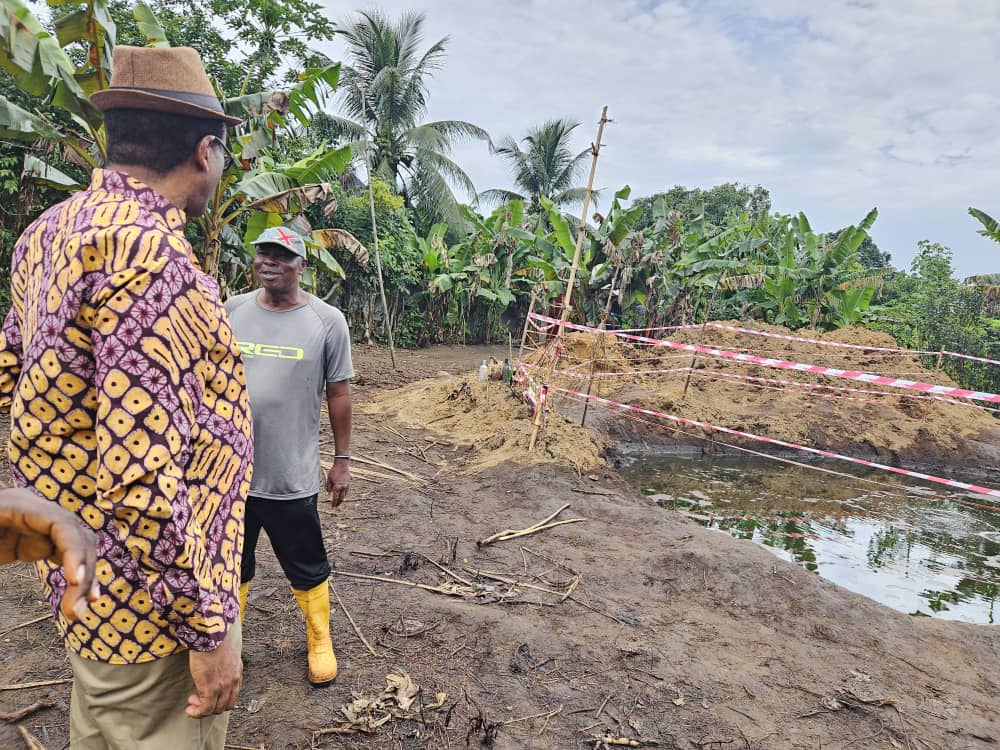
Field Work: Dr. Nnimmo Bassey at B-Dere. Credit: HOMEF
“It is unfortunate that those who make the laws break them, and those who should enforce them fail to act,” Egholo said.
The gap between policy and practice is further evident in the slow pace of environmental cleanup efforts.
The Hydrocarbon Pollution Remediation Project (HYPREP), established to implement cleanup in Ogoniland, has faced criticism over funding gaps and slow execution.
Experts estimate that full restoration of Ogoniland alone could take up to 30 years and cost billions of dollars.
“You see areas that have been cleaned, yet crude continues to seep from the ground,” Egholo noted.
Regulatory agencies, which are expected to enforce compliance, face significant operational challenges.
“It is troubling that regulators sometimes rely on the same companies they are meant to regulate for logistics, because they often lack the basic equipment needed to carry out their duties.”
“In some cases, they depend on oil companies for logistics such as helicopters and boats.This compromises their independence and affects the quality of their work.”
“We cannot expect positive outcomes when regulators rely on the same companies they are supposed to regulate.”
“As someone from the Niger Delta, I have always believed that the primary responsibility of government is to protect the interest of the people.”
“However, in Nigeria, the situation appears different. It seems as though the government is protecting the interests of oil companies at the expense of the people.”
“The government is supposed to be of the people, by the people, and for the people, but what we see is a system that favors the IOCs.”
“These companies have continuously destroyed the environment of the Niger Delta, yet they are not held accountable in the way they should be.”
“Those who are supposed to enforce the law are often used to undermine it. When communities speak out against injustice, they are sometimes met with force from security agencies. This creates fear and discourages people from demanding their rights.”
“Communities are worried about the future, especially with discussions about resuming oil exploration in Ogoni,” he said.
Beyond institutional failures, questions are also being raised about the management of funds generated from gas flaring penalties.
Alagoa Morris of the Environmental Defenders Network (EDEN) pointed to reports that significant sums from gas flaring fines have accumulated in the Central Bank of Nigeria.
“These funds have accumulated into billions of naira and are sitting at the CBN, instead of reaching the host communities,” he said.
For Morris, this represents a missed opportunity to provide relief to communities that have borne the brunt of environmental damage for decades.
“These are funds meant for people who have been exposed to gas flaring for years. They should be released to them,” he insisted.

Field work: Crude oil devastated water body from SPDC underwater pipeline at Obololi community, Southern Ijaw. Credit: Alagoa Morris.
However, he emphasized that financial compensation alone cannot address the underlying problem.
“Our people do not need to be gassed to benefit from fines. What they need is their health and environment restored,” he said.
“Our people have been exposed to gas flaring for decades, and their health has been severely affected.”
“Life expectancy in the Niger Delta is lower than in other parts of the country, largely due to environmental pollution.”
“Gas flaring should be stopped completely, not managed through fines. The government should not see gas flaring fines as a source of revenue.”
“There have also been issues with disagreements among community leaders over these funds.”
“This has contributed to delays in accessing the money meant for the people.”
“Transparency and accountability are critical at all levels, including within communities.”
“Many community leaders do not provide proper accounts of funds received. This creates mistrust and weakens collective efforts to demand justice.”
“If we want to hold the government accountable, we must first ensure accountability within our communities. You cannot demand what you do not practice.”
“There is also a need to discourage selfish approaches to activism. Shutting down oil facilities is not a sustainable solution.”
“It often benefits a few individuals while the majority continue to suffer. We need coordinated and collective action that prioritizes the common good.”
“State governments also have a role to play in development,” he noted.
Still, the broader Niger Delta reality remains one of stark contradiction—immense natural wealth alongside widespread environmental decline.
At the heart of the issue is a system that allows pollution to continue while generating revenue from its consequences.
As Nigeria looks toward a cleaner energy future, experts say the country must move beyond fines as a revenue stream and enforce stricter compliance, invest in gas commercialization, and prioritize the health and livelihoods of host communities.
Until then, the flames will continue to burn across the Niger Delta—serving as a constant reminder of the cost of inaction.