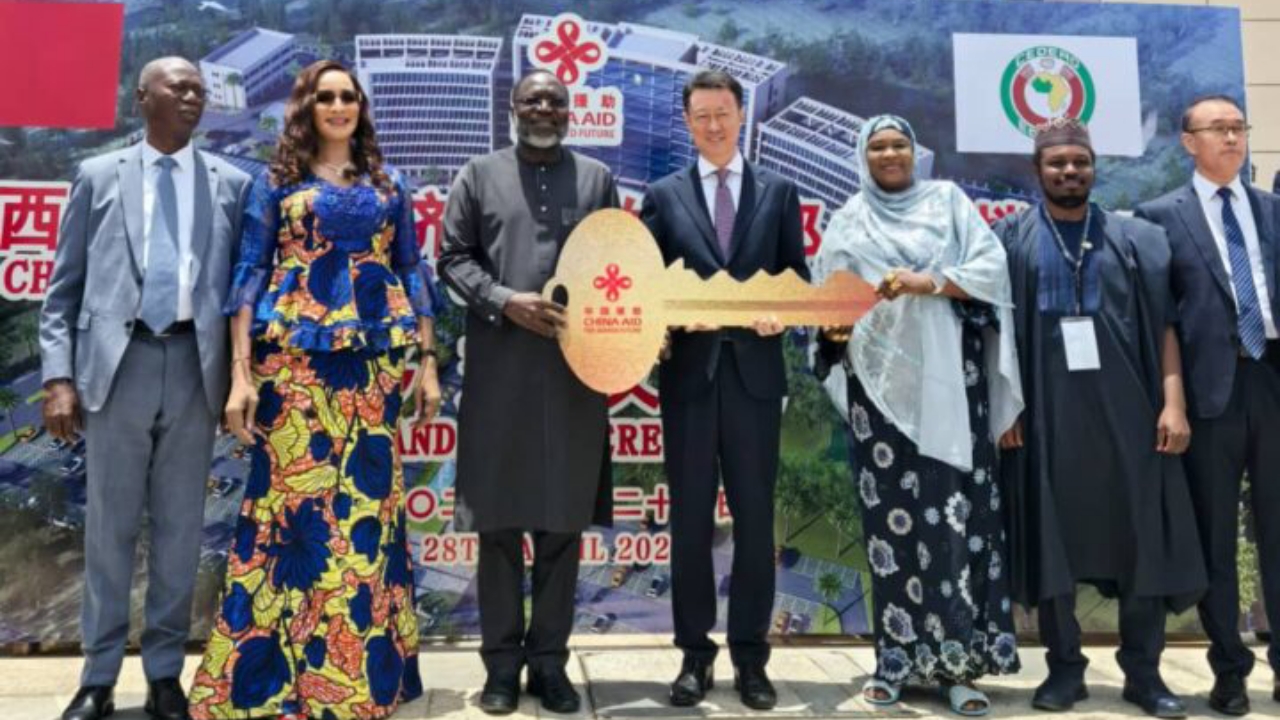
National News – China on Tuesday formally handed over a $56.5 million Economic Community of West African States (ECOWAS) headquarters complex in Abuja, Nigeria, in a ceremony attended by regional leaders, Nigerian government officials, and Chinese diplomats.
The project, financed by the Government of China, is aimed at strengthening ECOWAS institutional capacity and advancing regional integration across West Africa.
Completed after years of construction, the facility represents a strategic cooperation milestone between China and West Africa.
Chinese Ambassador Yu Dunhai described it as milestone, non-interference policy; ECOWAS boss Omar Alieu Touray sees trade opportunities; Nigerian Minister of State for Foreign Affairs Bianca Odumegwu-Ojukwu praised the facility as a strategic asset.
Local analysts interpret the development as China expanding its soft power footprint in West Africa, while public opinion remains divided—some citizens welcome the infrastructure boost amid funding gaps, while others question long-term influence and dependency risks.
Beyond symbolism, the headquarters is expected to improve ECOWAS administrative efficiency and strengthen regional coordination on trade, security, and development.
Officials believe it could ease decision-making processes within the bloc and support faster policy implementation across member states.
Analysts in Abuja note that China’s involvement also reflects growing geopolitical competition for influence in Africa, particularly as Western partners reassess engagement strategies.
Enhanced access to Chinese markets is expected to benefit agricultural exporters, especially in Nigeria and neighbouring economies, potentially reducing post-harvest losses that have long affected rural incomes.
The facility’s smart systems, digital infrastructure, and solar-powered design signal a shift toward modern governance spaces aligned with sustainability goals.
Some civil society voices, however, stress that member states must ensure transparent maintenance funding and avoid underutilisation, warning that large projects often face bureaucratic delays and funding gaps after inauguration.
Overall, the handover underscores deepening China–West Africa relations, blending infrastructure diplomacy with economic ambition.
While it may enhance ECOWAS visibility and functionality, its true impact will depend on effective utilization, transparency, regional commitment to shared goals, and stronger accountability in project management across member states efficiency.