
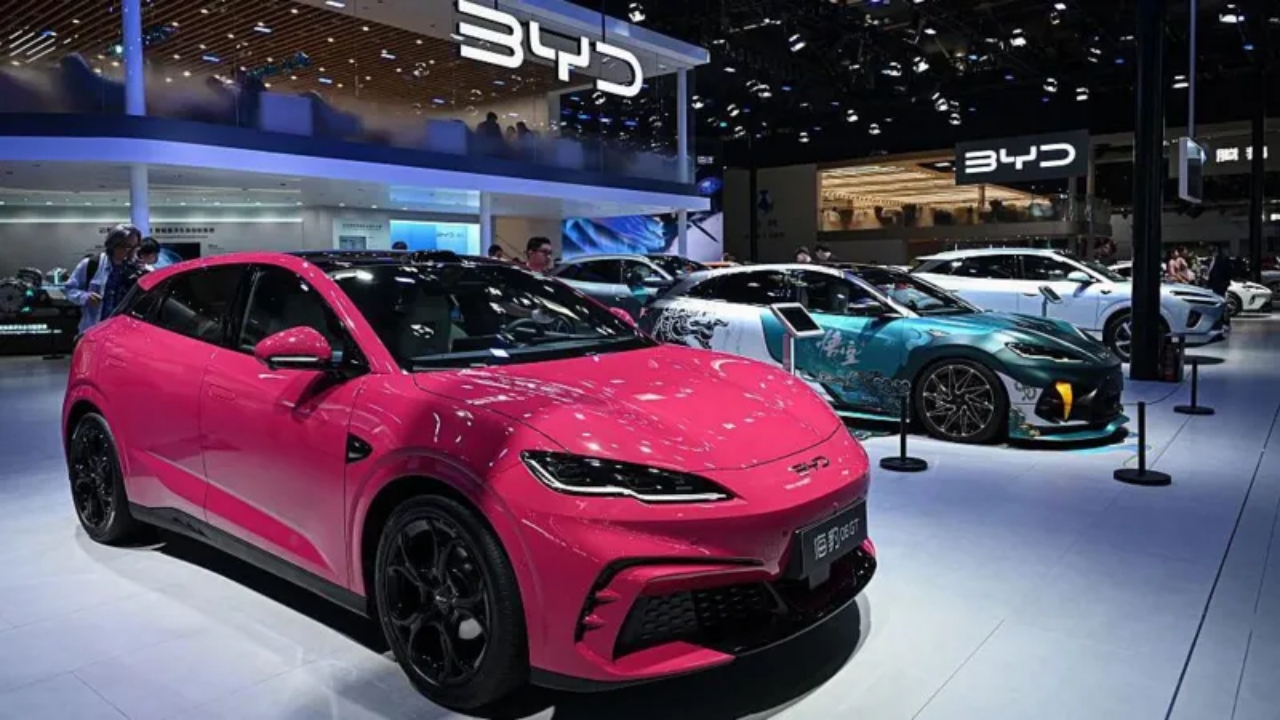
National News – Chinese electric vehicle giant BYD has said it can thrive without the United States market, a statement made at the Beijing Auto Show in China by executive vice president Stella Li.
The announcement comes as global fuel prices rise due to the war in Iran, boosting demand for electric vehicles across Asia, Europe, and Latin America.
The company is responding by expanding production and shifting focus away from the US, where tariffs and security concerns restrict entry.
The company, which overtook Tesla as the world’s top EV seller last year, is positioning itself as a global technology ecosystem rather than just a carmaker.
It produces batteries, solar systems, buses and software-integrated vehicles, aiming to capture markets where oil price volatility is pushing consumers toward cheaper running costs. BYD says demand now exceeds its manufacturing capacity.
A key strategy is its new flash charging system, designed to add hundreds of kilometres of range in minutes.
BYD believes this will reduce one of the biggest barriers to EV adoption—charging time anxiety—and strengthen competitiveness in Europe, the UK and Brazil.
However, intense domestic competition in China is squeezing margins, with prolonged price wars affecting sales.
While domestic demand has softened, European sales have surged significantly, reflecting stronger overseas acceptance of Chinese EV technology.
Geopolitically, Chinese EV firms face increasing scrutiny from the United States and its allies over subsidies and data security concerns, limiting access to the world’s largest automotive market.
This has forced BYD and rivals to double down on alternative regions and partnerships with global manufacturers.
In Nigeria, auto industry observers note that the shift could eventually influence West African markets, where affordability and fuel costs are major concerns.
Analysts suggest that if Chinese EV pricing remains competitive, adoption could accelerate, though infrastructure gaps such as charging stations remain a major challenge.
The broader implication is a reshaping of global automotive power, with China increasingly setting the pace in EV innovation while traditional Western dominance weakens.
Industry experts predict consolidation in China’s crowded EV sector as only a few large players survive long-term competition.