By Loveth Henry
National News
More than 300,000 people have been forced to flee their homes as devastating wildfires continue to spread across France and Spain, threatening major cities, destroying thousands of hectares of land and overwhelming emergency services. Authorities in both countries have warned that soaring temperatures and dry weather expected later this week could worsen the situation, with firefighters battling multiple blazes that remain largely uncontrolled.
In France, one of the largest fires is burning in the Gironde region, southwest of the country, and has advanced to within about 15 kilometres of the outskirts of Bordeaux. Thick smoke has blanketed the city, leaving residents increasingly anxious as the flames move closer. Many people have begun wearing face masks because of the poor air quality, while emergency officials continue to monitor the rapidly changing conditions.
Residents described scenes of fear and uncertainty as smoke spread across Bordeaux. Pierre Pourquery, who lives on the eastern side of the city, said many people were becoming “anxious and fearful” as the wildfire approached. He explained that some residents from the western parts of Bordeaux had moved in with friends and relatives further away from the flames, while concerns were growing over the toxic smoke, which has made breathing difficult for many people.
British nationals caught up in the crisis have also spoken of the disruption caused by the fires. Sarah, who travelled from Hertfordshire with her family for a holiday in Bordeaux, said they abandoned their trip after smoke engulfed the city. She recalled returning to their apartment after a visit to the river only to find the smoke so thick that it had seeped into every room despite sealing the windows and doors.
Another traveller, Georgia from Kent, said she cancelled her planned holiday after learning how serious the situation had become. Although her family relocated to France’s Loire region to continue their vacation, she said they now risk losing more than £3,500 because the accommodation provider refused to issue a full refund, arguing that the wildfire had not yet reached the exact area where they had booked to stay.
Residents living closer to the fire line have described terrifying experiences. Rachel Hanberry, a British resident near Bordeaux, said her community resembled a warzone after thousands of evacuees arrived at the town’s emergency shelter. She said frightened families wrapped in emergency blankets sought refuge while volunteers opened their homes to those with nowhere else to go. According to her, the emotional toll on residents has been enormous as entire communities fear losing everything.
Another resident, Jo Barnes, narrowly escaped disaster after a wildfire near the southern French town of Cotignac changed direction unexpectedly and swept towards her home. She said emergency services initially believed the blaze was under control before a “wall of orange flames” suddenly surged over a nearby hill, forcing her family to flee immediately. When they eventually returned several days later, they found their home still standing, although the surrounding landscape had been completely scorched.
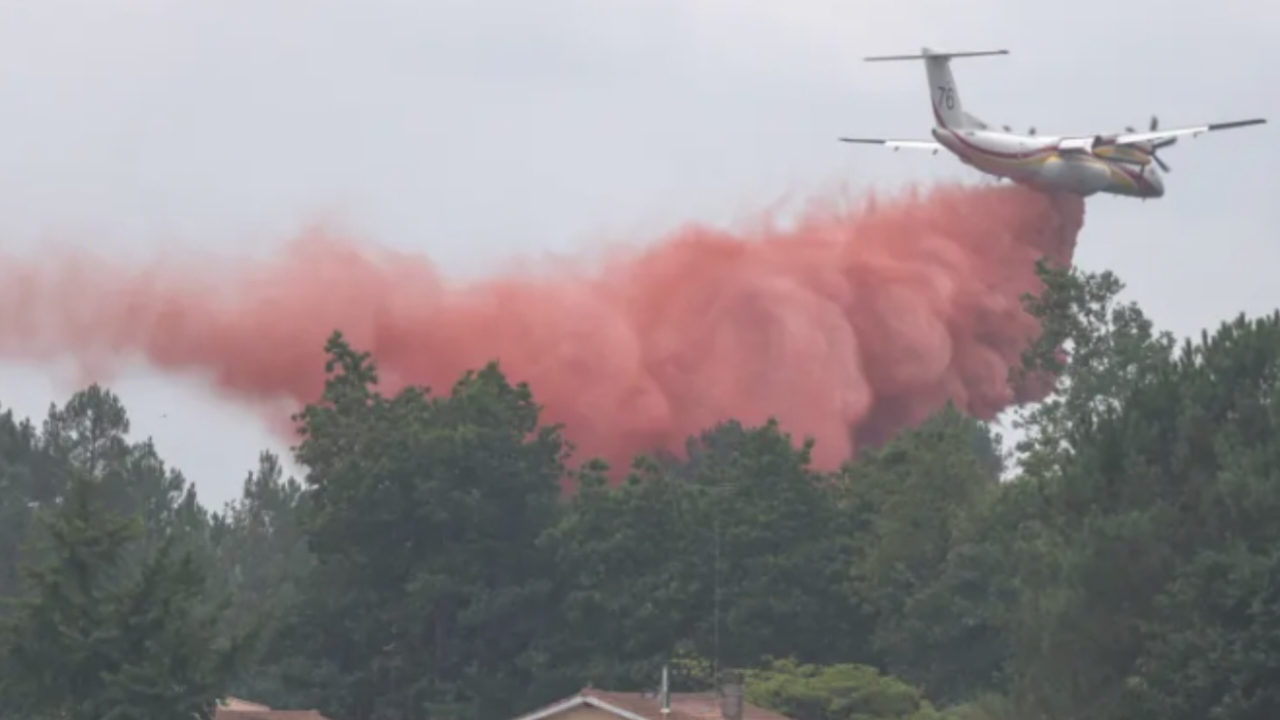
French authorities have deployed hundreds of firefighters, specialist aircraft and firefighting equipment to battle the flames. Bombardier Dash 8 aircraft have been dropping fire retardant over forests and vegetation in an effort to slow the spread of the fires. The retardant works by reducing the fire’s oxygen supply and slowing combustion, creating protective barriers that help firefighters contain advancing flames.
Despite the massive response, officials admit resources are being stretched. Jean-Luc Gleyze, President of the Gironde Departmental Council, said there are simply not enough firefighters or fire engines to position around the enormous fire front. While welcoming additional personnel and equipment arriving from other parts of France, he warned that the scale of the disaster has exposed the country’s limited firefighting capacity. He also called for changes in forest management, suggesting greater tree diversity rather than relying heavily on highly flammable pine forests.
French President Emmanuel Macron travelled to the Gironde region to assess the emergency response and meet firefighters, local authorities and rescue workers. His visit came as the government held emergency meetings over the worsening wildfire crisis. Although favourable winds and limited overnight rainfall slowed the fire’s advance temporarily, meteorologists warned that temperatures could climb above 40 degrees Celsius later this week, creating ideal conditions for the blazes to intensify once again.
Fire officials have cautioned that extinguishing the Gironde wildfire could take several months. Lieutenant Colonel David Annotel of France’s National Federation of Firefighters said the intensity of the blaze may reduce over time, but hotspots would continue burning for weeks, requiring extensive monitoring and firefighting operations. He warned that the forecast heatwave would once again favour the fire rather than the emergency crews trying to contain it.
Satellite imagery has revealed the enormous scale of destruction in the Gironde region. Images captured by the European Union’s Copernicus Sentinel-2 satellites show vast stretches of burned countryside stretching towards the Atlantic coast. Authorities estimate that more than 200,000 people have already been evacuated from the affected areas in France alone, with several major roads closed as firefighters struggle to prevent the flames from reaching more populated communities.
The extreme heat has also produced a rare weather phenomenon known as a pyrocumulonimbus cloud, or fire thunderstorm. These giant storm clouds form when intense heat from a wildfire forces hot air high into the atmosphere, generating powerful winds and lightning that can make fires spread even faster. Weather experts warned that these fire-generated storms complicate firefighting efforts by creating unpredictable fire behaviour.
Spain is facing a similar emergency. Wildfires continue to burn west of Madrid and in the eastern region near Valencia, forcing tens of thousands of residents from their homes. Around 60,000 people were evacuated from areas west of Madrid, while another 15,000 residents fled the coastal town of Vall d’Uixó near Valencia after flames scorched approximately 6,500 hectares of land.
Spanish Prime Minister Pedro Sánchez visited the emergency command centre in Valencia and warned that the country faces “difficult and complex hours” ahead as temperatures continue to rise. He urged citizens to remain extremely cautious and follow safety instructions issued by emergency services. Sánchez disclosed that about 150,000 hectares have already burned across Spain this year—six times more than during the same period in 2025. He also announced €10 million in funding for climate shelters, including facilities to protect schools and vulnerable communities during extreme weather events.
Regional officials in Madrid said the wildfire threatening the capital had slowed but remained active and uncontrolled. Authorities urged residents to remain vigilant, stressing that changing weather conditions could quickly reignite the fire’s advance. Madrid regional president Isabel Díaz Ayuso praised firefighters risking their lives on the frontlines, saying the country owed them immense gratitude for their sacrifice.
The wildfire emergency has also extended beyond France and Spain. In Italy, more than 400 people were evacuated by sea after fires swept through parts of the Adriatic coast in Puglia, while another blaze continued burning near Palermo on the island of Sicily.
Weather experts warned that dry conditions, limited rainfall and persistent high-pressure systems across southern Europe will continue to fuel the fires throughout the week. Although isolated showers are possible in some regions, they are not expected to significantly reduce the wildfire threat. Instead, forecasters expect temperatures to climb into the upper 30s and low 40s Celsius across parts of France and Spain, increasing the likelihood of new outbreaks.
Climate scientists say the intensity of this year’s wildfire season reflects a combination of natural weather patterns and long-term climate change. An unusually wet winter encouraged dense vegetation growth, which later dried out during a hot spring and repeated summer heatwaves, creating ideal fuel for rapidly spreading fires. Experts added that Europe remains the fastest-warming continent, with rising temperatures making wildfires more frequent, more intense and increasingly difficult to control.
Authorities in both France and Spain have urged residents and visitors to remain alert, obey evacuation orders and follow instructions from emergency services as firefighting operations continue across several regions. Emergency shelters, sports halls and exhibition centres are housing thousands of displaced people while firefighters race to contain one of Europe’s most destructive wildfire seasons in recent years.