
National News – President Bola Tinubu has formally asked the Nigerian Senate, led by Godswill Akpabio, to approve a $516 million external loan to finance critical segments of the proposed Sokoto–Badagry Superhighway, a project positioned as a major economic lifeline.
The request, presented during Thursday’s plenary, outlines a funding plan tied to a nine-year repayment window, including a three-year grace period, with financing expected from Deutsche Bank.
The administration argues that the highway—stretching roughly 1,000 kilometres from Illela in Sokoto to Badagry in Lagos—will link key commercial and agricultural hubs across seven states, significantly reducing travel time between the North-West and South-West from about 13 hours to six.
Officials say this will lower transport costs, ease the movement of goods, and strengthen food supply chains.
Beyond the numbers, the proposal reflects a broader strategy under the government’s “Renewed Hope” infrastructure push, prioritising large-scale connectivity projects to stimulate economic growth.
The financing model includes a partial risk guarantee from an international Islamic credit insurer, alongside federal counterpart funding exceeding ₦265 billion for land acquisition and compensation.
However, public reaction remains mixed. While some stakeholders view the highway as overdue infrastructure capable of unlocking regional trade, others question Nigeria’s growing reliance on external borrowing amid existing debt pressures.
Critics argue that without transparent execution and measurable returns, such loans risk deepening fiscal strain rather than delivering promised benefits.
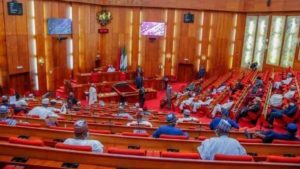
Within the Senate, lawmakers acknowledged the project’s potential but also emphasised the need for swift yet thorough scrutiny.
The proposal has been referred to the Committee on Local and Foreign Debts, with a one-week deadline for review—an indication of urgency, but also of the political weight attached to the initiative.
If approved and efficiently executed, the highway could redefine logistics across Nigeria’s economic corridors.
But its success will ultimately depend not on ambition alone, but on disciplined implementation, accountability, and the government’s ability to convert borrowing into tangible national value.