

National News
Excerpts – Rev. Joseph Hayab, Country Director of Global Peace Foundation Nigeria and Chairman of the Northern Christian Association, has raised serious concerns over the resurgence of killings and insecurity in Kaduna State and Northern Nigeria, warning that political interests, weak government response, and lack of trust between citizens and authorities are worsening the crisis.
Hayab said insecurity in Kaduna has evolved from religious and communal clashes to banditry, kidnappings and terrorism, noting that criminals have taken advantage of poor government response and security lapses to intensify attacks on communities.
He also expressed concern over what he described as a new wave of killings in recent months despite earlier successes recorded under Governor Uba Sani.
The cleric further advised the government to move from reactive measures to proactive operations, urging authorities to take the fight to terrorists as the only path to a decisive breakthrough.
In this exclusive interview with National News reporter, Jesse Ese, Hayab speaks extensively on insecurity in Kaduna State and Northern Nigeria, its causes, humanitarian impact, and solutions.
THE FULL REPORT
Please, can you tell us a little about yourself?
I am Rev. Joseph Hayab, the Country Director of Global Peace Foundation Nigeria. I have been in the leadership of our ecumenical organization called CAN since 1999. I’ve held several offices in that organization, from Local Government Secretary to the State Secretary, and later the State CAN Chairman, and now to a regional organization, the Northern Christian Association, where we try to protect, defend and advocate for Christian rights.
How would you describe the security situation in Kaduna and other parts of Northern Nigeria, and how has it affected communities, particularly in terms of religious harmony, livelihood and social stability?
Insecurity in Kaduna State has remained, or has continued despite efforts to ensure that it is nipped. Kaduna security challenge has been there for a very long time. First it was like a religious violence or communal clash, or farmers/herders conflict. But, add to that, are some deliberate actions by some people to suppress others. And, in reacting to their deliberate actions, it has led to some of the violence. Then comes the banditry that Kaduna has suffered, and then the attacks in many Kaduna communities.
Different leaders have come, shown commitment, made efforts to restore sanity, eg. Alhaji Mohammed Ahmed Makarfi. During his reign as governor, he set up structures that will further help to mitigate this violence or address the security challenge.
He set up a Bureaux for Religious Affairs (Christian Matters) and another one for Islamic matters. He also set up a segregation prevention committee because of the tension. There has been segregation in this city, so he set up quick response committee. He also set up the most important one – the religious harmony committee.
Since then, the violence comes in different phases, but they are always fueled, induced and promoted under religious cover.
So Makarfi did his best, and when he left office, Muhammad Namadi Sambo came and also tried his best and established what we knew then as Operation Yaki. I remember the former President then was Vice President – His Excellency, Goodluck Ebele Jonathan. He came for the official commissioning of the Operation Yaki.
NGOs worked among communities to promote harmony. There were establishment of chiefdoms trying to site development in every part of the state so that people would have a sense of belonging, and the tensions reduced.
If my memory did not fail me, the last tension during Ahmed Makarfi was on November 21st or 22nd 2002, and Kaduna people were able to handle that crisis and began to build bridges for nine years without any serious reaction again.
Nine years later, we went back to another drama – that is the post election violence of 2011. And since that happened, it seems the criminals, the bandits, the terrorists that were imported into the country, into that area for purposes of politics did not leave, and they turned the ethnoreligious violence that we know to be a child’s play.
They went into a killing spree – killing children, killing women, burning places of worship, attacking and kidnapping people for ransom. And they continued this throughout the eight years of Governor Nasir El-rufai.
Unfortunately, the government didn’t act responsibly. Government didn’t show that they were willing to protect their citizens, and these killings continued.
But you must give credit to Uba Sani because when he came, he started reaching out. He took us back to the old days of Makarfi or the pattern – the style of trying to win people. And for some time, the killings subsided. The killings even ceased. Places like Birnin Gwari and other parts of Southern Kaduna that were a no go area, people started visiting, markets were reopened.
But in the last three to four or five months now, a new wave of killing and attack has come up. And it’s a little difficult to interpret, although for those of us who have been around for a long time, we suspect there’s politics in it.
We suspect this is a deliberate way of saying okay, before people get used to clapping for you, let them know that you too can fail. And that’s why there is need for all citizens to wake up and expose anybody whom they know has a hand in this.
And the governor and his team must also wake up to find a way of sustaining the success they started having before these unfortunate killings came back. Because if you really want to have a good name and complete your time with a good testimony, then the most important thing is to give your people security.
If people are secure, they will go to school. If they are secure, they will go to farm. If they are secure, they will merry. If they are secure, they will do everything.
Did you notice some of the recent killings? People were attacked during merriment because the enemies of the state do not want people to merry. They want people to be mourning. They want people to be afraid. They want people to be living in fear and confusion.
What do they stand to gain? Probably just to discredit some people in politics or in government, while the real thing is not. And the enemies of Kaduna State know how sensitive religion can be, and so they always attack people with some semblance of religious identity just to trigger problem.
And that’s why the government and every citizen must wake up and expose anybody involved in it. I used to say, for those who care to listen, that if the criminal, if the enemy of peace is my brother or goes to our church or comes to our mosques or we’re in the same community and I know him, I’ll be the first to expose him. Because the damage he’s doing to the state affects me, it affects my children and will also affect my grandchildren.
It is further dividing the people. It is creating lack of trust among the people. It is making people not to even love themselves. Look, there’s no way you can even develop a community when there is no peace.
Many communities have experienced banditry, kidnappings and other violent crimes in recent times in Kaduna State. What do you believe are the root causes fueling these security challenges in the state?
One, political, two, economic. For those who go about kidnapping people and collecting ransom, they know how they can make money from it.
I know some of the people who came back from the kidnappers den, who confessed to us how the kidnappers would tell them that when they kidnapped certain categories of people, they know people will raise money in church to pay their ransom.
So, you see, there’s economy in it, but there’s also the political aspect. There’s also the evil heart. And another reason is the inability of our government to be decisive — it’s also a contributing factor to this crime.
Everywhere in the world, people are tempted to commit crime. But they will cease to commit crime when they know that government is decisive, government will come after them, government will arrest, expose them, prosecute them and jail them.
But if government just keeps paying lip service to issue of insecurity, these people will continue to have their way. And that is where the whole pain is; seeing people struggle to look for money to pay bandits huge ransom. And these bandits just use it to continue to get more weapons to do more evil.
So, we shouldn’t support the economy of the bandits. We shouldn’t even support their religious idea. We shouldn’t even support them to disrespect our government and our rules. We should stand up together, fight and expose them until our country is free from their terror.
As a religious/human rights leader, what do you think is the psychological and humanitarian impact of insecurity on vulnerable groups such as women, children, and displaced persons?
The truth about it is that many families have lost their breadwinners. Many families have not been able to train their children.
This is because it’s either they don’t have the resources or they borrowed money to bring back any of their loved ones that was taken away by bandits, and they are living the rest of their lives just trying to get money to pay back.
Banditry and insecurity have caused lack of food. And you know, when you have hungry people around, you have angry people around. And an angry man can be used by the devil to do terrible things.
Sometimes in our reactions to what the bandits have caused us, what the terrorists have caused us, we end up reacting negatively and thereby causing damage to our future, our infrastructure and our society.
So the truth is that, as a faith leader who stands for human rights, I feel strongly that insecurity has denied us the joy of being creative.
You see, it’s only when a man is free that he can be creative, that’s when he can think. But a man in bondage cannot think or implement what he thinks. And in the absence of good thinking, there will never be something good to produce.
So psychologically, insecurity has caused so many people to go…. — let me put it from the angle of faith. Insecurity has even made some people to start abandoning issues of faith and are now going into fetish practices and going into evil practice.
In one of the villages I know very well, a very well informed, educated person today has become….., is it a spiritualist or someone who gives charms to young people so that knife will not penetrate them? And you see beautiful cars being driven to that village just to go and collect that charm.
And I felt, oh my God, look at how insecurity has caused people to lose their conscience to knowing what is right and they are now accepting what cannot help them. The man who is even giving them that charm — ask him whether knife cannot enter him.
So people are becoming fetish, abandoning faith. Insecurity is causing so much on faith that people are feeling, ‘why should I continue to have faith when evil comes and then there’s nothing that is happening? And evil doesn’t want to understand good; it understands violence, so let me give it back to him.’
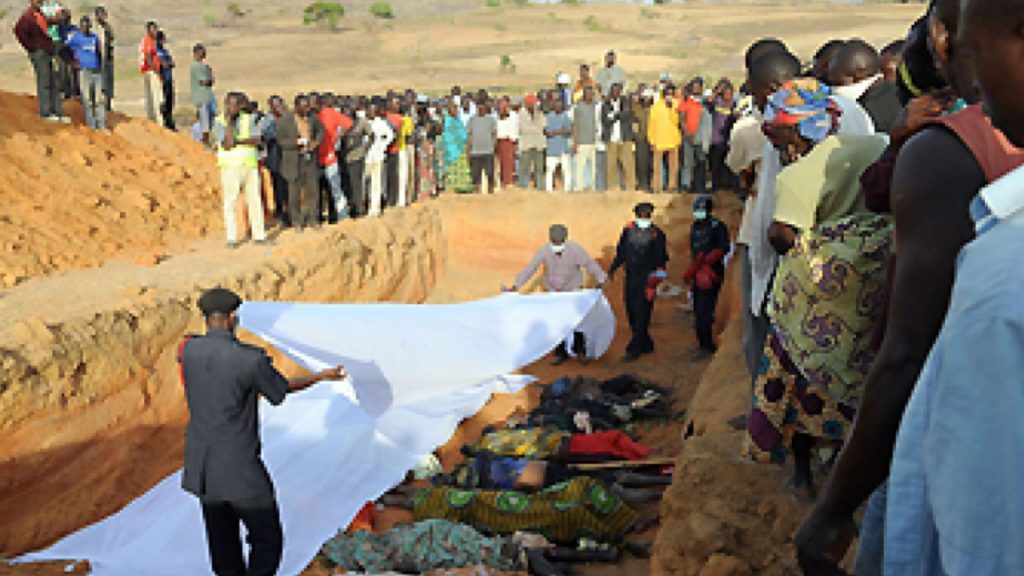
That’s how terrible insecurities have caused us. We no longer trust our neighbours. We no longer believe in anybody. Look, there’s even a very strong chasm between the people and their leaders, because we just feel that because they have failed or because they may have not done what we think they should do right, so they’ve cost us all these pains.
People no longer sleep. Imagine someone who cannot sleep very well, you will not be healthy. So insecurity has caused the society so much. Insecurity has actually brought about poor education, and today, to just have children to pass, you have to do some funny things because most times schools are closed the moment there’s insecurity. And when it is within examination time, it’s just to find a way of making them write exams. And even when they didn’t write well, you just pass them. And that’s why we are producing people who are not qualified.
So insecurity has cost us so much. No trust, there’s no good relationship anymore. Our education is affected, our economy is affected, our food supply is affected. So you can see why terrible things are happening in our society.
How would you assess the response of government and security agencies to the insecurity in Kaduna and the broader northern region? What areas require urgent improvement?
Their response is too slow. The truth is that government will tell you today they are making effort, but tomorrow, even before the criminals will leave, they have abandoned where they are protecting.
Government will station security agencies at a place because of an insecurity challenge that happened yesterday. But they don’t know how to sustain them. They don’t keep them long.
See, the criminals are smarter and wiser. They will come back and check if the security they saw last night are still there. And the moment they are not there, they will strike.
And sometimes, there’s so much impatience because of lack of proper remuneration or motivation to the security agents. When you send them on an assignment somewhere, they don’t last long, they leave. And the moment they leave, the criminals will strike.
Sometimes, the security agencies would delay. You are calling them to go and they will delay in coming and until the evil is done.
Several times, when people are kidnapped and you run to the security crying, they will tell you ‘just go and keep negotiating.’
Until the day you negotiate and pay money and your people will come back, they’ve done nothing. So it’s making people not to even trust what they are doing.
But I have a strong belief in the security agencies. I have a strong belief in their ability. I have a strong belief in their capability. I just want to appeal that they should wake up. They should wake up.
And any governor, whether in Kaduna or anywhere, there must be a good understanding between government and the people.
The governors or the executive or those in power should have a good understanding with the security agencies. And the government and security should have good relationship with the people.
Sometimes, when you listen to what the security agencies are telling you, I think they are saying a different story from what those in power are saying.
So if you are in leadership, listen to them. They know the story. Let them tell you. Just as they also need to hear from us because we also have a role to play in securing our communities.
Any security agent that thinks he knows everything is making a mistake. Any governor that thinks he knows everything is making a mistake. So, there must be synergy between the community, security agencies and those in power so that together we can fight this.
The effort is there, but it’s not good enough. It has not really been convincing — you clap for them today, tomorrow worst thing will happen. And you now have to begin to swallow your words — you earlier said they were wonderful, and what do you say tomorrow?
People want to see a consistent effort in addressing insecurity, in hitting at them. Look, if you want to pursue them, pursue them. Why do we wait until they strike before we go after them? And that’s why they will strike, withdraw and leave as if there’s nothing. We go back and they strike again.
But we should take the fight to them since we know they are criminals, since we know they are evil people, since we know they are tormenting our citizens, since we know they’ve caused us so much. Let’s take the fight to them and let them know we are serious.
Sometimes, we hear that the forests are big. See, are we saying that we don’t have enough security that we can comb certain forests within one week and clear it and then move to another and move to another?
There are also technological strategies that we can use to weaken every enemy of the state and take charge. We are the owners of the country. We are the ones with power. But non-state actors seem to be looking stronger than state actors. I think something is wrong there.
Let’s build the confidence of Nigerians. Let them trust that security can do something. Let them see it at work. It’s not just talking; let them see it at work.
Let’s not make security fight a rhetoric exercise. We are making it seem like a rhetoric exercise, and that’s why people just think the larger thing we are saying or the security or government is saying is lie.
And I don’t even understand why security agencies will be yet on the paper. They don’t need that. We don’t need to see their faces on television. We don’t need to read about them. We just need to hear someone telling us the effort they’ve done.
What practical steps should the federal and state governments take immediately to restore peace, protect lives, and rebuild trust among affected communities?
Restore peace, protect life and rebuild trust among affected communities. It’s to first win the trust of the community.
There’s a trust deficit between the people and their government, the people and their security agencies, the people and those who are leading them.
Sometimes we just think the people don’t understand, but the people understand, they are watching us, they are reading us.
Can we build trust…..? Rebuild trust and do away with the trust deficit that has made people not to trust us, and then we back our words with action.
People have heard us talk and never do what we say. People have heard us bark but we bark like a toothless bulldog. People have heard us shout, but we shout and don’t still go after those who have caused them pain.
Justice seems not to be done for the victims. The victims just feel that this whole game is like “I suffered and nobody is held accountable.” So the federal government and state government must deliberately take steps to show that justice is being done for victims. Because for now, they see it that those who caused them pains are being treated with kid gloves. And that’s where I have problem with the whole theory of rehabilitating bandits.
In most cases, those bandits are not even repentant bandits. They were simply just arrested – and to arrest a criminal is different from a criminal realizing he’s doing wrong and is sorry.
These people are not sorry. You arrested them when they were going to do their crime and locked them up, and because they have been cut off from their friends and cut off from their normal lifestyle, and then you feel that they have repented? They have not repented.
Don’t call criminals who are still hardened, criminals who are still just looking for opportunity to go back, criminals who are still looking for opportunity to cause more damage…, don’t call them repentant.
There’s a difference between repenting and someone whom you just arrest.
The money, the investment the federal government puts into the so called repentance process is huge, and in the end, these same repented people are the ones causing us the death of senior military officers, causing us the death of our security agents.
We should look at it deeply. It’s not fair. We cannot be risking people’s lives like that. But I have hope that we have great people in this country who desire to see peace. And all we need is how can we truly identify, work together and make this country what we want her to be.
Those who are leading us are not visitors, they are our brothers, they are our friends. You came out from us, you knew about our pains, and you cannot go into government and forget that we are suffering. In fact, when you took oath of office, you took oath of office to defend and protect us. So keep to your words.








One Response
Just desire to say your article is as surprising. The clearness on your
submit is simply spectacular and i can assume you’re
a professional on this subject. Fine along with your permission allow me to seize your feed to stay updated with approaching post.
Thanks 1,000,000 and please keep up the rewarding work.