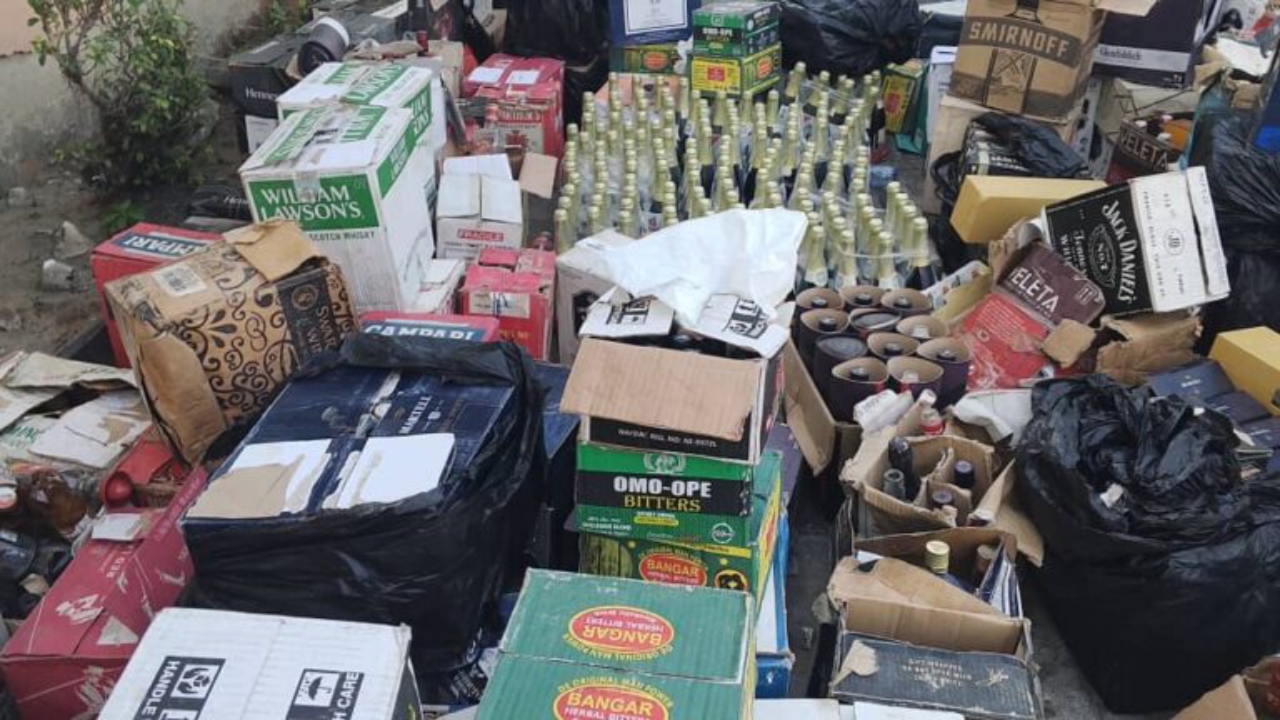
National News – A sweeping enforcement operation by National Agency for Food and Drug Administration and Control has exposed the scale of Nigeria’s counterfeit alcohol trade, after officials dismantled illegal production hubs and confiscated fake beverages worth an estimated ₦350 million across key commercial zones in Lagos.
The coordinated raids, triggered by intelligence reports, targeted hotspots including Trade Fair Complex and Lagos Island, where underground operations were quietly producing adulterated drinks for distribution into mainstream markets.
Inside these facilities, regulators uncovered improvised equipment—plastic mixing tanks, filtration setups, reused branded bottles, and packaging materials—pointing to a well-organised network rather than isolated offenders.
Authorities confirmed the arrest of at least one suspect linked to retail distribution, suggesting that the illicit supply chain stretches from production to point-of-sale.
All seized goods have been secured for further investigation and possible prosecution.
Beyond enforcement, the development highlights a deeper public health concern.
Experts warn that counterfeit alcohol often contains toxic substances capable of causing organ failure or sudden death.
This raises urgent questions about consumer safety in a market where fake products can closely mimic legitimate brands.
Local reactions in Lagos reflect growing anxiety.
Traders within affected markets admit that distinguishing genuine from fake products has become increasingly difficult, while some consumers expressed fear over what they may have unknowingly consumed.
Public trust in retail alcohol channels may face further strain if regulatory visibility does not improve.
Economically, the implications are equally significant.
Industry stakeholders have long argued that illicit trade erodes government revenue and undermines legitimate manufacturers.
The latest crackdown reinforces calls for tighter surveillance, harsher penalties, and better public awareness campaigns.
In the broader context, this operation signals a shift toward more aggressive regulatory action.
However, sustained success will depend on consistent enforcement, collaboration with market unions, and consumer vigilance.
Without these, the counterfeit ecosystem could quickly adapt and resurface.
For now, the message is clear: the fight against fake alcohol is no longer a periodic exercise but an ongoing battle with serious consequences for health, business, and public confidence.