By Friday Temitope Eugenia
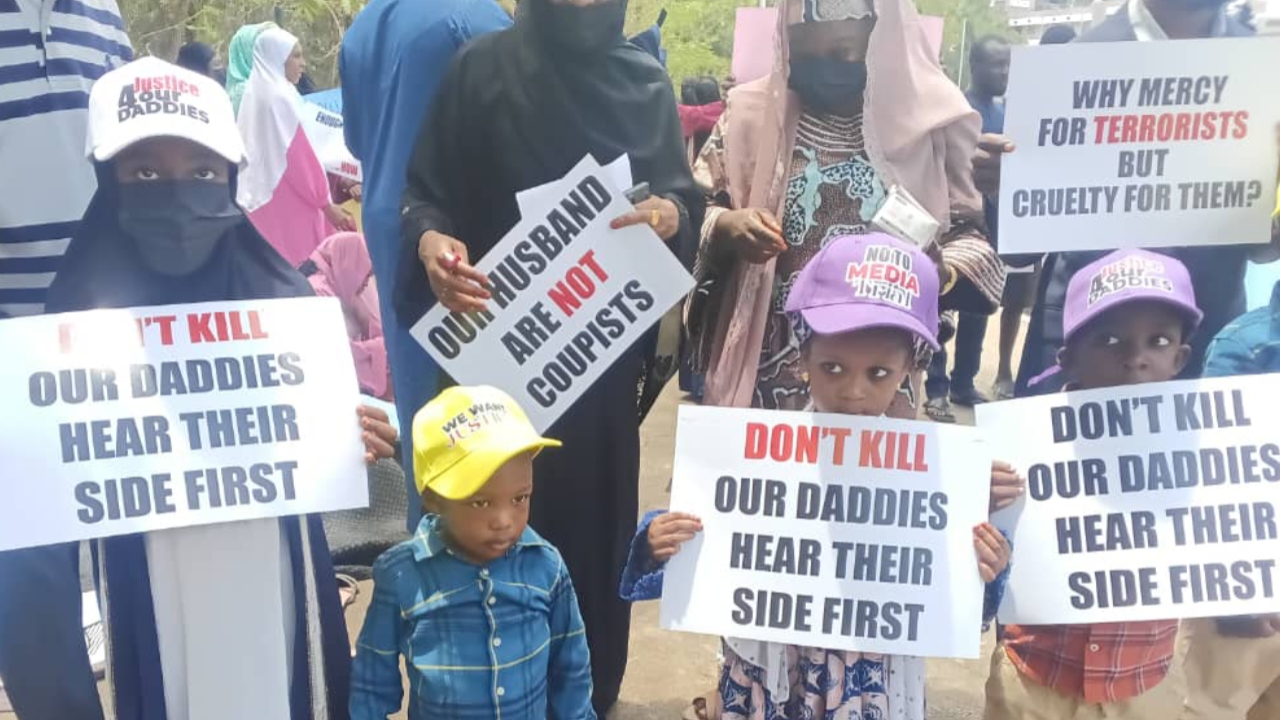
National News – Beyond the gates of the National Assembly in Abuja on Wednesday, the protest was quiet, peaceful, and yet deeply unsettling. There were no angry chants or violent confrontations — only the soft voices of children, the anxious faces of wives, and placards bearing messages that cut deeper than political slogans.
“Don’t Kill Our Daddies.”
“Detention Without Trial is Injustice.”
“Six Months of Torture: Enough Is Enough.”
These were not the words of political activists or civil society groups. They were the voices of families — wives and young children — of military officers detained over an alleged coup plot.
A Protest Led by Children
Among the protesters was eight-year-old Halima Mohammed, whose father has been in custody since October 2025. Fighting back tears, she pleaded with authorities to allow families see their loved ones.
For Halima, the alleged coup plot is not a matter of national security or politics — it is the sudden absence of a father, the silence at the dinner table, and the emotional strain that has reshaped her young life.
Nine-year-old Ibrahim Bala echoed similar pain. He said he had not seen his father in months and deeply missed the guidance and presence he once took for granted.
Then there was four-year-old Fatima Yusuf, too young to fully understand the situation, yet old enough to know her father is gone. Her message was simple — she just wanted him to come home.
Their voices transformed what might have been another political protest into a powerful human story — one that highlights the ripple effects of prolonged detention on families left behind.
Wives Speak Amid Uncertainty
While the children’s voices stirred emotion, the wives brought urgency to the protest.
One of the spouses, Nana Ibrahim, questioned why the officers had remained in custody for over six months, despite reports that investigations had been completed.
She called on authorities to either release the detained officers or formally charge them in court.
For many of the families, the protest was not about declaring innocence or guilt, but about due process and access — the basic right to see their loved ones and know their fate.
Their concerns were reinforced by legal representatives and human rights advocates who accompanied them, arguing that prolonged detention without trial raises serious constitutional and humanitarian questions.
The Alleged Coup Plot
The detained officers — reportedly more than 16 — were arrested in October 2025 following allegations of a planned coup against the Federal Government.
Investigations allegedly revealed plans to conduct surveillance of key national locations, including the Presidential Villa, military installations in Abuja, and major international airports.
October 25, 2025, was reportedly set as the planned date for the operation.
While authorities continue to investigate the matter, families insist that justice must not be delayed indefinitely.
The Silent Burden on Families
Behind every detained officer is a family struggling to cope with uncertainty. For many, the absence of a breadwinner has created financial strain, emotional distress, and psychological pressure.
Children miss school events without their fathers present. Mothers shoulder responsibilities alone. Families live in limbo — unsure whether to hope for release or prepare for prosecution.
This protest, therefore, was not just about legal rights. It was about families trying to hold on to normalcy while navigating a crisis they did not create.
A Plea for Justice
The protesters vowed to continue their peaceful demonstrations until authorities either release the detained officers or bring them before a court of law.
As the children slowly dispersed from the National Assembly grounds, their placards lowered but their message remained clear — behind every national security issue are ordinary families whose lives are deeply affected.
And sometimes, the loudest call for justice comes not from politicians or activists, but from children simply asking for their fathers to come home.
The Ripple Effects of Actions
The scene at the National Assembly also serves as a sobering reminder that actions—especially those taken in positions of authority—often carry far-reaching consequences beyond the individuals directly involved.
Decisions made in moments of ambition, frustration, or miscalculation can ripple outward, affecting spouses, children, and entire families who must bear emotional and economic burdens.
The sight of young children pleading for their fathers underscores the importance of careful reflection before engaging in any act that could jeopardize not only one’s future but also the well-being of loved ones.
In the end, every action has consequences, and those consequences are rarely borne alone.